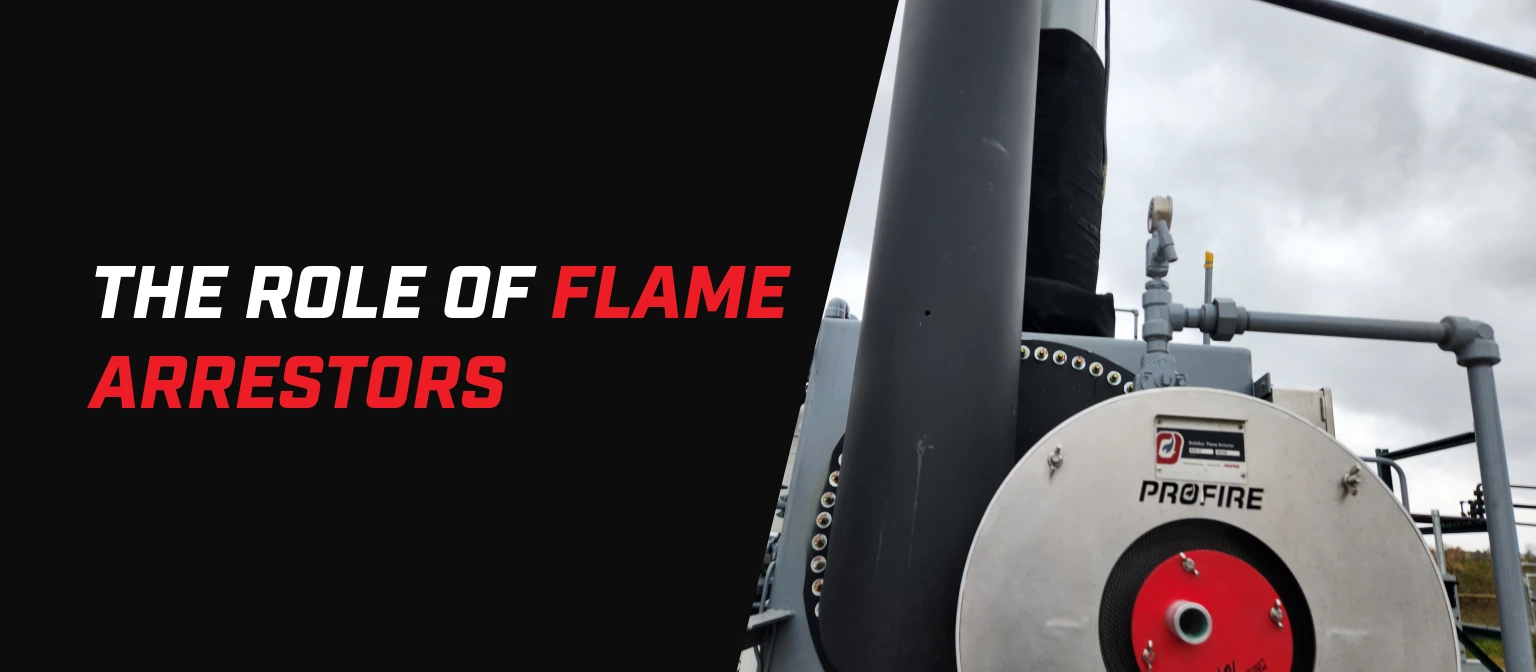
The Role of Flame Arrestors in a BMS: A Safety & Compliance Necessity
By Profire TeamAugust 26, 2026
Flame Arrestors for Industrial Burner Management Systems
A flame arrestor, also spelled flame arrester, is a passive safety device that allows combustion air or gases to flow through a rated element while stopping flame propagation through the protected pathway.
In a burner management system (BMS), it adds a mechanical safety layer at the air intake of an industrial burner or firetube heater. It doesn’t replace BMS logic, flame detection, shutdown sequencing, or proper fuel-train design, but it helps reduce flashback risk where combustible mixtures and ignition sources are present.
Flame arrestors are easy to overlook until airflow drops, flame stability changes, or a flashback event exposes a weakness in the combustion system. On firetube heaters, heater treaters, line heaters, glycol dehydrators, and similar equipment, the right industrial flame arrestor helps protect people, equipment, uptime, and compliance.
When specifying flame arrestors for a burner management system, treat the arrestor as one part of the wider burner safety package. It works alongside flame supervision, fuel shutoff, purge timing, ignition control, and field maintenance practices to help keep the burner operating within its intended safety envelope.
Why Flame Arrestors (Flame Arresters) Matter in a Burner Management System
A BMS manages burner sequencing, flame supervision, permissives, alarms, and safe shutdown. It is an active control layer. A BMS flame arrestor is different: it is a passive mechanical barrier that helps stop a flame front from propagating through the combustion air path if flashback occurs.
That distinction matters in the field. The BMS may detect loss of proven flame or another unsafe condition and close the fuel train according to the configured shutdown sequence. The flame arrestor helps limit the physical path a flashback can travel before that shutdown sequence completes. For firetube heater safety, both layers need to be selected, installed, inspected, and maintained correctly.
How a Flame Arrestor Works: The Quenching Mechanism
At the core of every flame arrestor is a densely packed element of narrow channels formed by crimped metal mesh, corrugated metal, or structured cells. Those channels are selected for the fuel-air or vapor-air mixture in the application. One important design reference is the Maximum Experimental Safe Gap (MESG), which describes the largest gap through which a flame will not propagate under defined test conditions for a given gas group.
When the element channels are sized below the applicable flame-propagation threshold, the flame front loses heat to the metal surfaces faster than combustion can continue through the passage. That heat transfer is the basis of flame quenching.
Here is what happens when a flashback flame reaches the arrestor body:
Flashback event sequence inside a flame arrestor (flame arrester)
A flashback flame travels upstream through the combustion air pathway toward the arrestor body.
The flame front enters the element’s narrow channels, which are too small to sustain propagation for the rated mixture and conditions.
Heat from the burning gases transfers rapidly into the metal channel walls, lowering the gas temperature below the point needed to sustain combustion.
The flame is quenched within the element. Airflow continues through the designed flow path, subject to the arrestor’s rated capacity and pressure-drop limits.
The BMS detects loss of proven flame or another unsafe condition and closes the fuel train according to the configured shutdown sequence.
Because the element works mechanically, it does not depend on controller logic, actuation, or external power during a flashback event. That passive function is why flame arrestors remain an important safety layer in BMS-protected combustion equipment.
Most natural-draft firetube heater applications use deflagration arrestors designed for subsonic flame fronts. Applications involving enclosed piping, higher-energy explosive mixtures, long pipe runs, or vapor-handling systems may require detonation-rated arrestors engineered for supersonic flame fronts. Correct selection starts with the fuel group, installation position, operating conditions, and applicable standard.
Flame Arrestor Types: Installation Classification
Before selecting a housing style, identify how the flame arrestor will be installed. The two fundamental classifications are end-of-line and in-line flame arrestors.
End-of-line flame arrestors
Mounted at an open pipe end, vent, or burner air intake. This is the common configuration for many natural-draft burners and firetube heaters, including heater treaters, line heaters, and glycol dehydrators. These units face atmospheric conditions and help stop flashback through the intake path.
In-line flame arrestors
Installed within an enclosed piping run to help stop flame propagation through confined vapor or gas systems. They are common in vapor recovery, storage tank venting, and process piping applications, and they require ratings appropriate to the pressure and flame-propagation conditions in the line.
For many natural-draft firetube heating applications, an end-of-line arrestor at the burner air intake is the correct starting point. The body style then determines airflow capacity, heat-input range, service access, and how the arrestor fits the equipment layout.
Flame Arrestor Body Styles
Profire flame arrestor bodies come in three configurations, constructed from metals, mesh screens, and cell elements suited to the specific operating environment. Body selection should happen during heater or burner design because the housing affects airflow capacity, BTU/hr rating, inspection access, and maintenance time.
Single Body
For single-firetube, lower BTU/hr applications. Compact construction suits installations where routine cell access is limited or less frequent.
Hinged & Clamped
A two-piece housing that opens for cell inspection, cleaning, and replacement. This design supports routine service in demanding field environments.
Box Style
Built for high BTU/hr applications requiring multiple flame cell banks through one housing, including larger burners and high-capacity process heaters.
All three are available in standard and custom sizes to match specific combustion process requirements. Selection depends on airflow demand, burner capacity, inspection frequency, site access, and environmental exposure.
Single Body: typically used for single firetube applications with lower BTU/hr requirements.
Hinged and Clamped: a two-piece design that allows easier firetube access for service and maintenance.
Box Style: designed for high BTU/hr applications that require multiple flame cells through the housing.
Maintenance: What Happens When Flame Cells Get Blocked
A flame arrestor is passive, but it is not maintenance-free. The same element that helps stop flame propagation can also collect dust, debris, insects, corrosion products, condensate residue, or process contaminants. As the element fouls, pressure drop can increase and combustion air can fall below the burner design requirement.
A partially blocked flame cell can disrupt the air-to-fuel ratio, reduce combustion efficiency, increase emissions, create unstable flame conditions, and cause nuisance BMS trips. In severe cases, damaged or incorrectly cleaned cells can also compromise the arrestor’s ability to quench a flame front.
Follow these maintenance practices to keep your flame arrestors in good operating condition:
Inspect flame cell elements at intervals defined by manufacturer guidance, site conditions, and applicable code or AHJ requirements.
Perform an early first inspection after commissioning to establish how quickly debris, corrosion, or process residue accumulates.
Clean cells according to manufacturer guidance and avoid methods that could deform the element or enlarge the channels.
Check housing seals, clamping hardware, fasteners, and mating surfaces for corrosion, wear, or improper fit after service.
Confirm cell alignment during reinstallation because misalignment can reduce arresting effectiveness and create air leaks.
Inspect immediately after any fire, explosion, or suspected flashback event before returning the equipment to service.
Document inspection findings, cleaning actions, replacement parts, and technician observations for maintenance and compliance records.
Replace cells that show deformation, corrosion pitting, channel enlargement, cracked welds, or other damage.
For hinged and clamped configurations, inspection and cleaning are easier to complete during routine site visits. Single body and box-style units may require more disassembly. In either case, a technician who understands both the arrestor and the burner system will catch more than a visual-only check.
Compliance: Regulatory Requirements and Standards for Flame Arrestors
Flame arrestors can be required by code, equipment design, site standard, authority having jurisdiction (AHJ), or operating permit. The exact obligation depends on the equipment, fuel, hazard classification, installation location, and jurisdiction, so requirements should be verified for each application rather than treated as universal.
OSHA oil and gas extraction standards point operators to applicable 29 CFR 1910 requirements, consensus standards, and hazard-control obligations for oil and gas work. EPA NSPS OOOOb and related OOOOc emissions guidelines define requirements for affected oil and natural gas facilities, including control-device performance, monitoring, reporting, and recordkeeping. These frameworks do not replace an application-specific combustion safety review.
Common standards and frameworks to consider during flame arrestor selection include:
OSHA 29 CFR 1910: General Industry requirements and hazard-control obligations
ISO/IEC 80079-49:2024: flame arrester performance requirements, test methods, and limits for use
CSA and Canadian electrical, combustion, and installation requirements where applicable
Site-specific PSM, insurance, owner-operator, and AHJ requirements
Regulatory requirements continue to evolve, and combustion equipment can fall under multiple safety, environmental, electrical, and site-specific frameworks at once. Working with a combustion management partner helps ensure flame arrestor selection, BMS configuration, inspection practices, and documentation fit the actual application.
Where Flame Arrestors Are Deployed
Natural-draft and firetube combustion applications exist across many industries. In oil and gas, flame arrestors are commonly found on heater treaters, line heaters, glycol dehydrators, test separators, and tank battery process heaters. A heater treater flame arrestor, for example, helps protect the combustion air path on equipment where fuel, heat, and process vapors may be present in the same operating area.
Profire flame arrestors are deployed across:
Oil & Gas (upstream, midstream, downstream): heater treaters, line heaters, glycol dehydrators, separator vessels, and process heaters.
Biogas and Renewable Natural Gas: conditioning skids, biogas flares, and combustion engine fuel supply systems.
Landfill Gas: gas collection headers, flare systems, and engine-generator fuel lines.
Pulp & Paper: process steam generation and recovery boiler systems.
Municipal Wastewater: digester gas handling and combined heat and power (CHP) systems.
Chemical and Refining: fired heaters, thermal oxidizers, and process burners.
Power Generation: combustion turbine air intakes and duct burners.
Where combustible gas, ignition sources, and air-intake pathways create a flashback hazard, flame arrestor selection should be part of the burner safety review.
Frequently Asked Questions About Flame Arrestors
What is a flame arrestor?
A flame arrestor, also spelled flame arrester, is a passive mechanical safety device that allows combustion air or gases to flow through a rated element while stopping flame propagation through the protected pathway. In burner applications, it is commonly installed at the combustion air intake to help prevent flashback from reaching upstream areas of the system.
What is the purpose of a flame arrestor in a burner management system?
In a burner management system (BMS), a flame arrestor adds a passive mechanical safety layer at the combustion air intake. The BMS monitors flame status and shuts the fuel train down when unsafe conditions are detected, while the flame arrestor helps stop flame propagation through the intake path during a flashback event.
How does a flame arrestor work?
The flame arrestor element routes a flame front through narrow metal channels selected for the applicable gas-air or vapor-air mixture. The channels absorb heat from the flame front, lowering the gas temperature below the level needed to sustain combustion. Airflow continues through the rated flow path, subject to the arrestor design and pressure-drop limits.
What is the difference between an in-line and end-of-line flame arrestor?
An end-of-line flame arrestor is mounted at an open pipe end, vent, or burner air intake. It is the common configuration for many natural-draft firetube heaters, heater treaters, line heaters, and similar equipment. An in-line flame arrestor is installed within an enclosed piping run and must be rated for the pressure and flame-propagation conditions in that line. The two types are not interchangeable.
What are the three body styles and when is each used?
Single Body: compact design for single-firetube, lower BTU/hr applications.
Hinged and Clamped: two-piece housing that opens for cell inspection, cleaning, and replacement.
Box Style: multi-cell housing for high BTU/hr applications requiring more flame cell area, such as larger industrial burners and process heaters.
Are flame arrestors required by OSHA or EPA?
In many industrial combustion applications, flame arrestors may be required or expected based on equipment design, hazard classification, site standards, AHJ requirements, or applicable regulatory frameworks. OSHA, EPA, NFPA, CSA, and other requirements should be evaluated against the specific equipment and jurisdiction rather than treated as a universal one-size-fits-all rule.
How often should flame arrestors be inspected?
Inspection frequency should follow manufacturer guidance, site standards, applicable code requirements, and operating conditions. A first inspection within the first few months of operation is a practical baseline, followed by routine inspection at least annually in many field applications. Harsh, dirty, corrosive, or high-fouling environments usually require more frequent checks. Any fire, explosion, or suspected flashback event should trigger inspection before the equipment returns to service.
What is the difference between deflagration and detonation flame arrestors?
Deflagration arrestors are designed for subsonic flame fronts, which are typical of many natural-draft burner and firetube heater applications. Detonation arrestors are designed for higher-energy, supersonic flame fronts that can occur in certain confined piping systems. Correct selection depends on fuel group, installation position, piping geometry, operating pressure, temperature, and applicable standards.
Get the Right Flame Arrestor with Profire
Our team at Profire will match the flame arrestor body style, flame cell configuration, airflow requirements, and maintenance access to your burner application, whether you are working with a heater treater, line heater, glycol dehydrator, or other industrial combustion equipment.
Talk to our team of experts to add the right flame arrestor to your system!
Tell Us About Your Application
A Profire Specialist Will Contact You Within 24 Hours