Glycol Degradation and the Real Cost of Replacement
By Profire Team
August 6, 2026
If you run glycol for natural gas dehydration units, replacing the glycol charge is one of those costs you plan around and mostly accept. The invoice shows up every so often, someone signs off, and the unit goes back to work.
That invoice is the part everyone sees. It’s also the smaller half of the story. When a unit comes down for a changeout, the gas it was drying stops moving through the compressor station, and the site earns nothing on that stream until it’s back online. The quieter risk is worse: a unit limping along on degraded glycol that starts sending wet gas downstream, where it can corrode pipe and form hydrates.
Here’s the part most teams don’t act on. Glycol doesn’t degrade at random. It breaks down mostly because of how it’s heated and circulated, which means a real share of that cost is something you can influence.
This article covers:
Why glycol degrades, and what actually drives it
What a replacement event costs once you count downtime, not just the chemical charge
How circulation rate drives both glycol degradation and emissions
How automated circulation control extends glycol life and optimizes performance
Why glycol degrades in dehydration service
To better manage glycol costs, we first need to understand why the glycol breaks down in the first place. Glycol earns its keep by absorbing water from the gas stream, then returns it to the reboiler so the same charge can be reused. That regeneration cycle is also where the wear happens, because it puts the glycol through repeated heating. Each cycle stresses the glycol’s molecular bonds until they break down, and when they do, that part of the fluid stops behaving like glycol and dilutes into the water. You lose drying capacity and usable product at the same time.
Of the three glycol types used in dehydration (ethylene, diethylene, and triethylene glycol), you’ll most often see triethylene glycol (TEG) paired with a glycol pump, mainly for its higher temperature rating. In this case, you’ll sometimes see this referred to as TEG degradation.
Heat is the main driver of glycol degradation. Your reboiler is generally trying to hold the glycol around 374°F / 190°C, which is where it should run. Once it climbs into the 399 to 410°F / 204 to 210°C range, it’s running too hot and the glycol starts breaking down in earnest. Overheating also flashes glycol off as emissions instead of keeping it in the loop.
That heat is the first of three glycol degradation drivers, and it does the most damage. Overfiring is the single biggest cause of glycol degradation. A unit that runs too hot damages the glycol long before its age or hours in service would suggest, so glycol that’s been in the system “too long” has usually already been overheated. Time and contamination fill out the other two: glycol has a service life like any working fluid, and many sites charge it once and never look at it again, while contaminants carried through the vessel cause internal fouling. But if you fix one thing, fix the overfiring.
The gap between those two numbers is downtime. A planned swap (drain, clean, and inspection of the still-column trays) runs about 8 to 10 hours. A forced shutdown from a major glycol degradation problem runs closer to two days. Either way, the unit isn’t drying gas, and off-spec gas can’t be sent downstream, so the flow is shut in, not rerouted. You earn nothing on that stream until the unit is back online.
What makes this worse is how often units keep running on glycol that’s already degraded. The warning signs are usually there, higher moisture in the outgoing gas and a unit that won’t reach temperature, but many teams keep going rather than take the hit of stopping. That’s exactly when the risk moves downstream.
How circulation rate drives glycol degradation and emissions
The good news is that much of this is within your control, and the biggest lever is one most sites aren’t using: circulation rate. It cuts both ways. Under-circulate and the glycol can’t absorb enough water, so the gas leaves wet. Over-circulate and every extra gallon still has to be heated and regenerated, which adds thermal stress, drives up emissions, and can foam the fluid.
The right amount isn’t obvious. There’s a rough target for how much circulation a unit needs, on the order of three gallons of glycol per pound of water removed, but your water load isn’t fixed. It shifts with ambient temperature, incoming gas, and flow rate, so the right rate today isn’t the right rate next week. Most sites never adjust for it. On older units, an operator counts pump strokes against a site chart and leaves it. Newer glycol dehydration units have flow meters and electric drives but still get set once and forgotten. Either way, a fixed guess is sitting on top of a process that keeps changing.
When that guess runs high, the cost shows up in more places than glycol life. The reboiler burns extra fuel gas, pumps wear faster, and filters on both sides of the reboiler need changing more often. Emissions climb too, and close to linearly. Boiling water out of the glycol releases BTEX emissions (Benzene, Toluene, Ethylbenzene, and Xylenes volatile organic compounds),and the more you circulate, the more goes out the still vent, with methane released alongside it. Some jurisdictions now require thermal oxidizers to burn off BTEX before release, so this is turning an efficiency issue into a compliance one.
And the risk doesn’t stop at the unit. When circulation drifts and gas leaves wet, that water can corrode pipe, form hydrates that plug lines with ice, and foul equipment downstream. The circulation setting on one dehydration unit reaches a lot further than the unit itself.
How automated circulation control extends glycol life
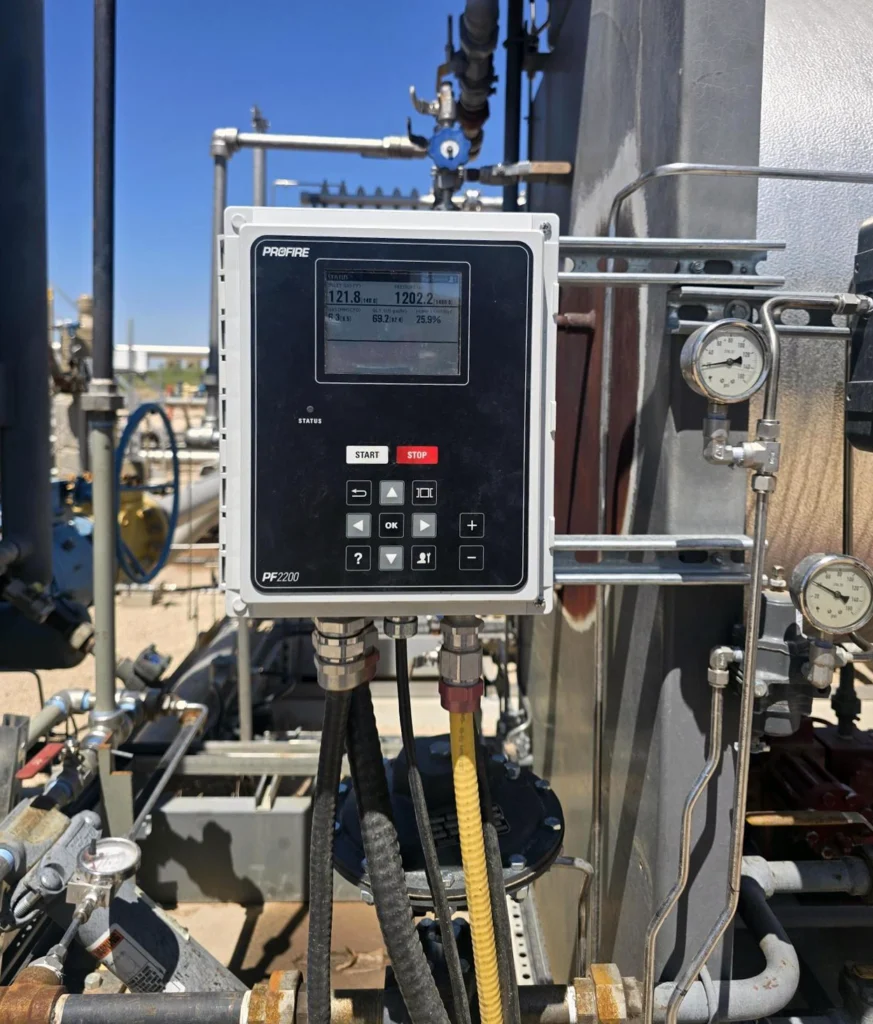
This is the gap the PF2200-GP is built to close. It works as a feed-forward system: your process is going to change, so the control changes with it. The controller reads real-time gas flow, pressure, and temperature, estimates the water content coming in, and adjusts pump speed as conditions shift, speeding up when more water shows up and easing off when the load drops.
Instead of a fixed, guessed setpoint, the unit runs to an allowable water target and holds it, raising circulation only when conditions call for it. That answers the obvious worry about cutting circulation back: dew point stays protected, because the controller adds flow whenever the gas actually needs it. Underneath, the pump speed runs on a 4-20 mA output, with open-loop control from the water-content estimate or closed-loop PID with glycol flow feedback where the application calls for it. Modbus RTU gives your team remote visibility into status and alarms, and event logging keeps a record of what the unit did and when.
Match circulation to demand and you cut the unnecessary heating and reboiler duty that age glycol fastest. That points toward longer glycol life, fewer replacement events, lower BTEX and methane emissions, and steadier performance. The PF2200-GP fits both retrofit and new installs, runs on the certified PF2200 hardware platform, and is rated for hazardous locations (Class I Div 2).
Is your circulation practice shortening glycol life?
Three checks give you a first read without new instrumentation:
Trend your glycol inventory. Steady top-ups mean glycol is leaving the system through flashing, carryover, or degradation.
Track dew point over time. A slow decline in drying performance is the glycol wearing out before it fully fails.
Log your reboiler bath temperatures. See how close you run to the 399 to 410°F / 204 to 210°C breakdown range.
If pump speed is fixed and you can’t say what your last replacement really cost you with downtime included, your glycol is probably working harder than the gas requires. Use these three checks to determine the best way to extend glycol life and reduce glycol degradation.
Frequently Asked Questions About Glycol Degradation
Why does glycol degrade in a dehydration unit?
Mostly from heat. The glycol is repeatedly heated in the regeneration cycle, and that thermal stress breaks its bonds down over time. A reboiler is usually holding around 374°F / 190°C, and degradation accelerates as the glycol climbs toward the 399 to 410°F / 204 to 210°C range. Time in service and contamination add to it, but overfiring is the dominant driver.
How much does glycol replacement cost?
A full glycol replacement costs upwards of $20,000 all-in for the glycol, draining, and disposal. That figure doesn’t include downtime, which can push the real cost two to three times higher once lost production is counted.
How often does glycol need to be replaced?
It varies widely. Some sites replace on a one-to-two-year cycle, while others run five years or more. In good conditions, with low contaminants, properly managed glycol circulation rate, and no overheating, a unit can go 8 to 10 years. Frequency depends heavily on how the unit is operated.
Does over-circulating glycol raise emissions?
Yes. Boiling water back out of the glycol releases BTEX, and the more glycol you circulate, the more BTEX goes out the still vent, with methane as well. Some jurisdictions now require thermal oxidizers to burn off BTEX before it’s released, so circulation practice is increasingly a compliance question, not just an efficiency one.
Can you extend glycol life?
Field experience points to yes, mainly by keeping the unit off the breakdown temperature and matching circulation to the actual water load instead of running a fixed, conservatively high setting. The size of the gain depends on the site, so it’s better understood as a real direction than a fixed number.
See whether circulation optimization fits your dehydration units
Fixed-speed circulation may be costing more than you realize. Excess glycol circulation can contribute to faster glycol degradation, increase operating costs, and bring your natural gas dehydration system closer to conditions that can compromise gas quality. When replacement time comes, the downtime and associated costs add up quickly.
Don’t wait for the next glycol changeout to assess your options.
Contact our team today to evaluate your dehydration application and see whether demand-based circulation could help improve efficiency, reduce maintenance frequency, and protect your operation.
Tell Us About Your Application
A Profire Specialist Will Contact You Within 24 Hours