How Glycol Pumps Work in Natural Gas Dehydration Units
By Profire TeamSeptember 10, 2026
A glycol pump returns regenerated lean glycol from the low-pressure regeneration side of a dehydration unit back into the high-pressure contactor. That return keeps triethylene glycol (TEG) circulating so the unit can keep pulling water out of the gas, and the pump stroke rate sets how much glycol circulates.
Ask most operators about the glycol pump, and you’ll get a description of a sound. It strokes at a certain pace; it has always stroked at that pace, and when it stops, you’ll hear about it. That’s the extent of the relationship on a lot of sites.
The pump deserves closer attention, because it sets circulation rate, and circulation rate reaches further than the pump does. It affects how dry the outlet gas runs, how hard the reboiler works, how quickly the glycol wears out, and the scale of emissions of benzenes and methane absorbed from the process gas. A pump that strokes steadily can still be moving the wrong amount of glycol.
This article covers:
How glycol pumps work in dehydration units
What the pump does and where it sits in the glycol loop
How the two common pump designs move glycol against contactor pressure
Why circulation rate matters, and what changes the rate your unit needs
How automated control keeps circulation closer to actual demand
What does a glycol pump do?
The pump is the component that raises glycol from regeneration pressure back to contactor pressure. That return is what makes the loop a loop. Glycol absorbs water from the gas, gives it up in the reboiler, and comes back to do it again, continuously, for as long as the unit runs.
TEG does the drying because it’s hygroscopic, meaning it pulls water vapor out of the gas stream on contact. Two terms describe it at different points in the cycle. Lean glycol has been regenerated and is low in water. Rich glycol is what leaves the contactor after absorbing water from the gas.
Where does the pump fit in the dehydration process?
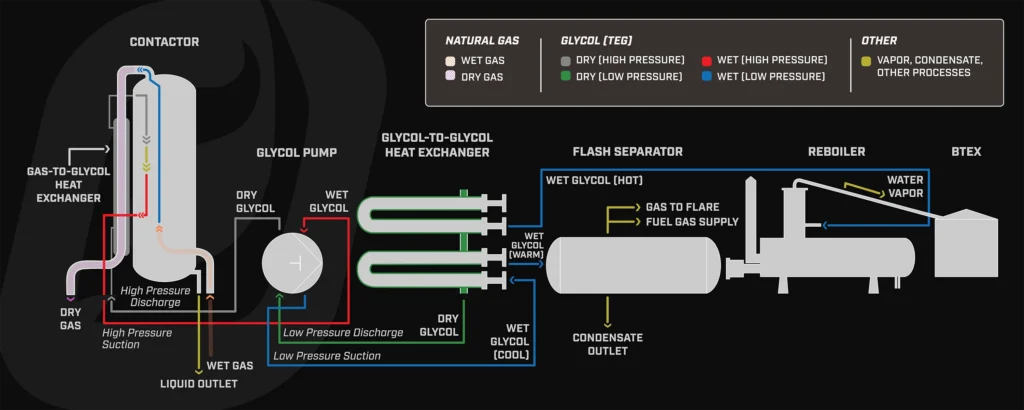
The TEG circulation pump sits at the end of the loop, between the regeneration side and the contactor inlet. Tracing the full cycle shows how glycol pumps work in context:
Lean glycol enters at the top of the contactor.
Wet gas rises while the glycol descends, so the two move counter-currently and the driest glycol meets the driest gas.
Rich glycol leaves the bottom of the contactor at contactor pressure.
Flash separation and filtration remove entrained gas and solids, where the unit is equipped for it.
Heat exchange and the reboiler drive off the absorbed water, returning the glycol to lean condition.
The pump returns it from the surge section to the top of the contactor, and the cycle repeats.
Step six carries the load. Everything downstream of the contactor runs at low pressure while the contactor runs high, and the pump lifts glycol back across that difference on every stroke.
What types of glycol pumps are used in dehydration units?
Two categories cover most units, gas-assisted energy-exchange pumps and externally powered pumps, and they differ in where the energy comes from. Both are positive-displacement machines. A piston or similar element draws a fixed volume in one side and discharges it on the other, with check valves keeping flow moving in one direction. Stroke rate sets circulation rate, which is why counting strokes is the usual field read on glycol pump operation.
Gas-assisted energy-exchange glycol pumps
A gas-assisted energy-exchange glycol pump runs on the loop itself, using high-pressure rich glycol leaving the contactor to drive a reciprocating piston assembly. On each stroke, one side discharges lean glycol toward the contactor while the other fills, then the reversing mechanism changes direction. Many designs supplement the rich glycol with a small volume of gas at contactor pressure to complete the stroke, which is where the gas-powered glycol pump name comes from. The tradeoff is emissions: the assist gas leaves with the glycol and adds to what the still vent releases. The still vent carries BTEX (volatile organic compounds including benzene, toluene, ethylbenzene, and xylenes) and methane driven off during regeneration. These pumps are common where reliable site power isn’t available, and automating one takes an added control valve on the drive line, covered below.
Externally powered pumps
An externally powered glycol pump uses a separate energy source, with an electric motor, hydraulic drive, or similar power source operating the pumping element. Larger units more often use this arrangement, and it’s the category where an external speed command becomes useful, since the drive can be adjusted directly.
Why does glycol circulation rate matter?
Circulation has to match the water the unit needs to remove. A common rule of thumb puts that at roughly three gallons of glycol per pound of water removed, but that is a starting point rather than a setting. The right number is a function of your unit’s design basis and the water load in front of it, and that load shifts with ambient temperature, incoming gas, and flow rate.
Circulation
What happens
What you tend to see
Too low
Not enough glycol to absorb the water present
Outlet gas trending wet or off-spec
Matched to demand
Water removed at the design basis, no surplus in the loop
Stable dew point, steady glycol inventory
Higher than needed
Surplus glycol still heated and regenerated every pass
Higher reboiler duty and fuel use, faster wear, more still vent emissions
Most units are set once and left alone, and that is where the cost starts. A fixed rate sits on top of a water load that keeps moving, and when the fixed rate is the higher one, the surplus gets heated on every pass. Repeated thermal cycling is a significant part of how operating conditions contribute to glycol degradation and replacement cost.
Emissions track circulation as well. Boiling water back out of the glycol releases BTEX and methane through the still vent, and some jurisdictions now require thermal oxidizers to burn off BTEX before release. That makes circulation practice a compliance question and a cost one.
What changes the required pump rate?
The rate a unit needed at commissioning may not be the rate it needs now. Gas flow moves, pressure and temperature move, inlet water content moves with them, and lean glycol concentration and contactor performance drift as the equipment ages. Seasonal and production swings push all of it further.
Will raising the pump rate fix poor dehydration?
Pump rate is one contributor to dehydration performance, not a master control. Raising circulation won’t correct poor regeneration, contaminated glycol, foaming, plugged filters, exchanger limitations, or a contactor problem. Reaching for the rate first can hide the actual fault while adding cost.
How can glycol pump control respond to changing conditions?
A fixed setting assumes a fixed water load. When conditions move and the setting doesn’t, the unit spends part of its time circulating more than it needs and part circulating less.
Manual adjustment closes some of that gap, but it depends on someone noticing the change, knowing the current water load, and having a reason to touch a pump that appears to be working. Those three things rarely line up.
How does a glycol pump controller adjust circulation?
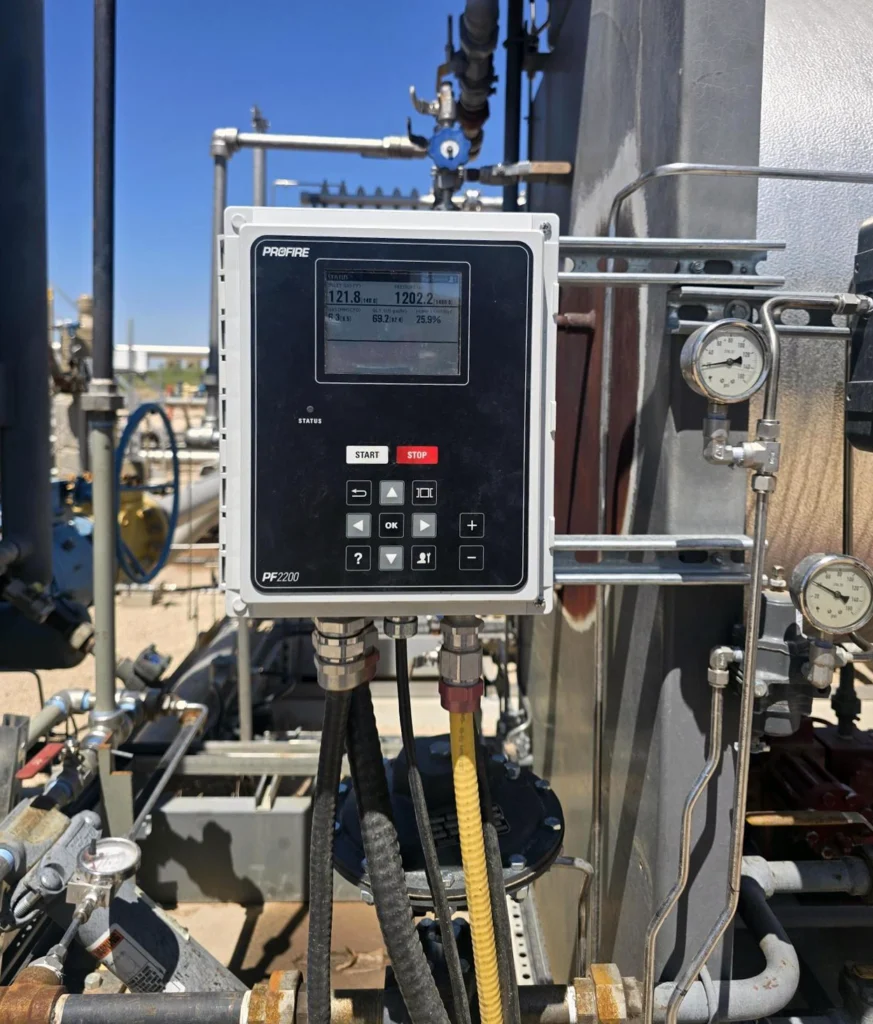
A glycol pump controller adjusts circulation from live process measurements instead of holding a fixed setting. The PF2200 Glycol Pump Controller (PF2200-GP) automates glycol circulation using measurements the unit already produces. It works feed-forward. It reads real-time gas flow, pressure, and temperature, estimates the water content coming in, and adjusts pump speed as conditions shift. Instead of holding a fixed setpoint, the unit runs to an allowable water target and raises circulation only when the gas calls for it, so dew point stays protected when the rate comes down.
Pump speed runs on a 4-20 mA output, open-loop from the water-content estimate or closed-loop PID with glycol flow feedback where the application calls for it. Modbus RTU gives remote visibility into status and alarms, and event logging keeps a record of what the unit did and when. The controller runs on the PF2200 hardware platform, is rated for Class I Div 2 hazardous locations, and fits both retrofit and new installs.
Can an energy-exchange pump work with automated control?
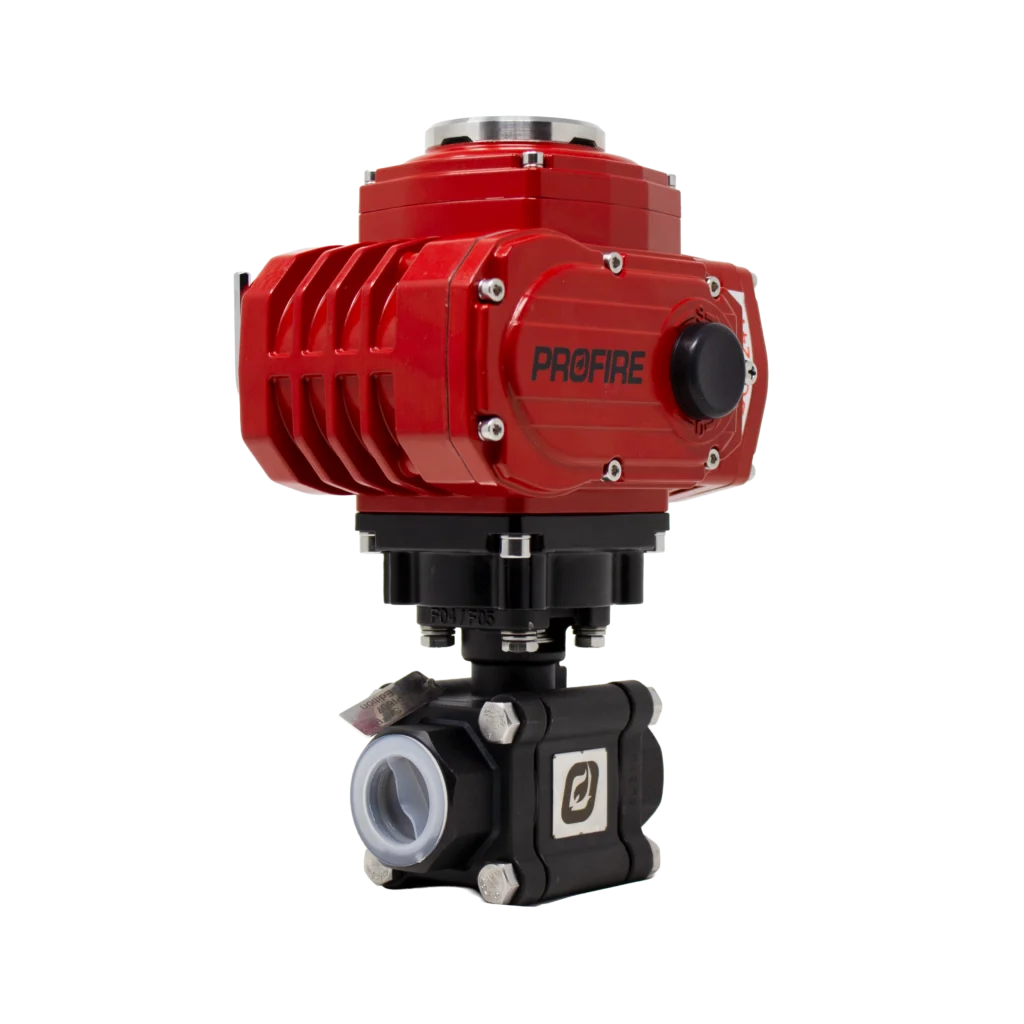
An energy-exchange pump can’t take the 4-20 mA speed command directly, because it has no drive of its own to accept a signal. The process turns the pump, not a motor. The retrofit path is a CV100-V control valve installed on the pump drive line. Valve position sets how fast the pump strokes, so the controller manages circulation by modulating the valve rather than by commanding the pump.
The valve is built for that duty. A V-notch port gives precise modulating control across a 100:1 turndown ratio, with 4-20 mA positional feedback and Modbus RTU reporting alongside the controller. Manual override with mechanical end stops keeps the valve operable by hand if the actuator is down.
Whether automated control fits a given site depends on the pump installed, the measurements available, and application review. It addresses circulation rate only. It can’t correct mechanical wear, contaminated glycol, or a regeneration or contactor problem.
Frequently Asked Questions About How Glycol Pumps Work
How do you know if glycol circulation is set too high?
To know if glycol circulation is set too high, trend your glycol inventory, because steady top-ups mean glycol is leaving through flashing, carryover, or degradation. Track dew point over time, since a slow decline in drying performance is the glycol wearing out before it fully fails. Log reboiler bath temperatures to see how close the unit runs to the 399 to 410°F / 204 to 210°C breakdown range.
How does a gas-powered glycol pump work?
It uses energy already in the loop instead of an external power source. High-pressure rich glycol leaving the contactor drives a reciprocating piston, often supplemented by a small volume of gas at contactor pressure. Each stroke discharges lean glycol while the opposite side fills, then the mechanism reverses. The assist gas adds to still vent emissions.
Can glycol circulation be too high or too low?
Both, and the more common failure is leaving the rate fixed while the water load moves. Too little circulation leaves outlet gas wet or off-spec. Too much means surplus glycol gets heated and regenerated on every pass, raising reboiler duty and fuel use, accelerating wear, and increasing still vent emissions.
How is glycol pump rate controlled?
On many units the TEG circulation pump is set manually and left alone, by adjusting stroke rate on an energy-exchange pump or drive speed on an externally powered one. A glycol pump controller can adjust a compatible pump-speed command automatically from real-time process measurements, keeping circulation nearer to actual demand as conditions change.
What is a typical glycol circulation rate?
A typical glycol circulation rate is roughly three gallons of glycol per pound of water removed. It is a starting point, not a setting. Water load shifts with ambient temperature, incoming gas, and flow rate, so a rate that matched the unit at commissioning may not match it now.
Match glycol circulation to process demand
A pump that strokes reliably can still run at the wrong rate, and that cost shows up quietly across gas quality, fuel, glycol condition, and emissions rather than as a single failure. If changing gas conditions make a fixed pump rate difficult to maintain, it’s worth knowing what your unit’s circulation demand looks like today.
Talk to the Profire team about your dehydration application and see how the PF2200-GP uses process measurements to support automatic glycol circulation control.